Sunday, November 22, 2009

Catagories of Tea;

Most teas can be categorized as one of three types: green, oolong, or black.

Green tea is completely un-oxidized and baked while fresh to lock in a sweet grassy flavor.


Oolong is semi-oxidized retaining many of the health benefits of green tea but resulting in a deliciously fruity tea that evokes the qualities of both black and green teas.


Black tea is fully oxidized producing a tea with higher caffeine content and a rich smoky flavor.

All tea was originally cultivated in Fujain, China, starting around the fourth century. Dutch explorers brought the marvels of tea to the west and since then, tea drinking customs have become common throughout out the world. :
Chinese Tang dynasty poet Lu Tong explains the magic of tea drinking best in this poem

“First cup moistens mouth and throat;
Second cup dispels loneliness and boredom;
Third cup makes the brain quick and lively, capable of writing five thousand volumes;
Fourth cup brings mild perspiration, draining all lifelong grievances through the pores.
Fifth cup refreshes muscles and bones;
Sixth cup brings communion with immortals;
No sooner has one drunk the seventh cup, than a cool breeze lifts one up from below one’s arms.”
Brewing Overview;
Advice on Brewing Fine Teas, Water is a critical element to brewing a good cup of tea, experts recommend using fresh filtered water. Bring water to a full boil and remove from heat. Water that is boiled too long loses oxygen and becomes flat. Filtered tap water is preferred over bottled water because it contains more oxygen.

Only the proper temperature will draw out the best flavors of the leaf. Tea should never be boiled. While boiling water can be poured directly onto black tea, water for green tea should be cooled slightly before added to the tea as to not bring out too much bitterness. On the other hand very hot temperatures bring out the subtleties of oolong teas. Traditionally, a small unglazed clay teapot, called a gungfu pot is used. The pot is first pre-heated by letting boiled water sit in the pot for a few minutes then removing this water and beginning to brew tea.

In the whole process of producing fine teas the tea has never been washed so the first step in brewing a delicious pot is washing the leaves. This is done be first pouring boiled water onto the dry leaves and quickly dumping out this first infusion letting the clean leaves remain in the pot for the next drinkable brew. The Chinese call this first infusion ’foot water’ and consider this tea only suitable for washing feet. After the initial washing, most teas can be infused three to five times. With oolong teas the second or third infusion is considered the choicest.

Tea leaves need to be fresh in order to deliver the true character of a tea. If stored properly, teas will keep their full flavor for many months. Teas should be kept in airtight containers in a cool dry space away from direct light and odors.

Our best black tea is a scintillating composition of Pure buds that are hand harvested from Yunnan’s ancient tea trees. Incorporating delicate processing and even fermentation to present a lovely leaf style tea that yields a smooth, sugary flavor. Experienced tea drinkers will note nuances of baked sweet yams and raisins. When brewed, Golden Needle Organic Black Tea has a very beautiful red color with spicy, floral qualities.
This magical hand picked, handmade black tea is from the protected Jing Mai ancient tea forest of Yunnan, China. Many of the tea trees are over 1300 years old and the forest is rich in bio-diversity and ecological balance. The ancient tea trees are the backbone of local minority Dai and Bulang villages’ economies. This is a world-renowned black tea imparting all the mysteries of the oldest tea-growing region in the world. In China, Golden Needle Organic Black Tea is reputed to relieve arthritis and is naturally very low in caffeine. The Jing Mai mountain villages are home to many centenarians, attesting to the health benefits of these leaves.
Golden Needle Tea, the most superb black tea, hails from Wu Yi Mountains of the Fujian province in China, whereas the province is one of its most prolific in teas. This region accounts for one-fifth of China's total tea output. And the high quality of its teas keeps them in high demand. This region's exports of tea used to be accounted for a quarter of the country's total. Fujian teas benefits from an excellent climate, combining mild temperatures, abundant rainfall and mountainous terrain. This tea shapes like shiny golden needles with one leaf and one bud. It has a long history of cultivating tea over one-thousand years and has been stepping in to a organic category

Wednesday, November 18, 2009

Omni Tea, Darjeeling, First Flush

Omni Tea, Darjeeling, First Flush


Most veteran tea tasters agree that First Flush Darjeeling tops their list of favorite black tea. The first crop harvest of the year, known as first flush, commands the highest price of all Darjeeling tea. Each year the best of the first flush is often pre sold to buyers in Germany and Japan and is rarely if ever tasted by American tea drinkers. The distinctive flavor and aroma of Darjeeling tea cannot be reproduced anywhere else in the world, as its unique character is fully dependent on several factors; microclimate, harvest season, soil, elevation, tea bush variety and the particular processing style and partial fermentation method developed in Darjeeling. It is truly the Champagne of Teas

Tea planting in the Indian district of Darjeeling was begun during 1841 by a Dr. Campbell, a civil surgeon of the Indian Medical Service. Campbell was transferred to Darjeeling in 1839 and used seeds from China to begin experimental tea planting, a practice that he and others continued during the 1840s. The government also established tea nurseries during that period. Commercial exploitation began during the 1850s.
Traditionally, Darjeeling teas are classified as a type of black tea. However, the modern Darjeeling style employs a hard wither (35-40 % remaining leaf weight after withering), which in turn causes an incomplete oxidation for many of the best teas of this designation, which technically makes them a form of oolong. Many Darjeeling teas also appear to be a blend of teas oxidized to levels of green, oolong, and black.
1st Flush is harvested in mid-March following spring rains, and has a gentle, very light color, aroma, and mild astringency.


Darjeeling Plant in Bloom

Prepared Darjeeling


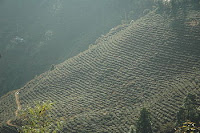
Darjeeling Farms in India


City of Darjeeling, India

*Note:
I have been informed by our supplier that, due to extreme weather conditions, that the first flush crop was almost entirely wipped out this year. I am however working with them to be able to offer a very high quality Second Flush Darjeeling. Thank You for your understanding

Jerome

Monday, November 16, 2009

Omni Tea, Keemun Mao Feng


Our newest Black, Tea Keemun Mao Feng, is from Hubei China. It is a smooth black tea and has full medium body flavor. Tea connoisseurs will note vestiges’ of fresh pine and brown sugar. Definitely a tea to add to your tea chest.
Keemun is a back Chinese Tea with a winey and fruity taste, with depth and complexity. Keemun is produced in the Qimen precinct of Anhui province in central China. "Keemun" was actually the English name for "Qimen" during the colonial era.Keemun has a relatively short history. It was first produced in 1875 by a failed civil servant, Yu Quianchen, after he travelled to Fujian province to learn the secrets of black tea production. Prior to that, only green tea was made in Anhui. The result exceeded his expectations, and the excellent Keemun tea quickly gained popularity in England, and became the most prominent ingredient of the Breakfast Tea blend.
The aroma of Keemun is fruity, with hints of pine and floweriness (but not at all as florid as Darjeeling tea) which creates the very distinctive and balanced taste. Keemun contains less caffiene than Assam tea. The tea can have a more bitter taste and the smokiness can be more defined depending on the variety.Keemun is typically enjoyed without milk or sugar; however it goes well with milk as well
Keemun Mao Feng: A variety, where Mao Feng means Fur Peak, which is made of only slightly twisted leaf buds and is sometimes noted for a smoother and different flavor. Many people prefer to brew the tea for a considerable amount of time, in fact up to 7 minutes, while using a smaller quantity in order to bring out more interesting tones in the tea

Sunday, November 15, 2009

Omni Tea, Lychee Red Tea


This smooth and mild liquoring China black tea is infused with the sweet essence of tropical lychee fruits. This classic Chinese flavor, is often served in Hong Kong cafes as a strong brew that is blended with pieces of canned lychee and ice for a cool summer drink


A major early Chinese historical reference to lychees was made in the Tang Dynasty, when it was the favourite fruit of Emperor Li Longji (Xuanxong)'s favoured concubine Yang Yuhuan (Yang Guifei). The emperor had the fruit, which was only grown in southern China, delivered by the imperial messenger service's fast horses, whose riders would take shifts day and night in a Pony Express-like manner, to the capital. (Most historians believe the fruits were delivered from modern Guangdong, but some believe they came from modern Sichuan.)
In the Chinese classical work, Shanglin Fu, it is related that the alternate name, meaning leaving its branches, is so-called because once the fruit is picked it deteriorates quickly.
The lychee was first described in the West by Pierre Sonnerat (1748–1814) on a return from his travel to China and Southeast Asia.
It was then introduced to the Réunion Island in 1764 by Joseph-Francois Charpentier de Cossigny de Palma. It was later introduced to Madagascar which has become a major producer.

The lychee (the U.S. Food and Drug Administration spelling) or laichi and lichu is the sole member of the genus Litchi in the soapberry family Sapindaceae. It is a tropical fruit tree. It is primarily found in China, India, Madagascar, Nepal, Bangladesh, Pakistan, Taiwan, Vietnam, Indonesia, Thailand, the Philippines, Southern Africa and Mexico. It is a fragranced fruit with a sweet taste.
It is a medium-sized evergreen tree, reaching 15–20 m tall, with alternate pinnate leaves, each leaf 15–25 cm long, with 2-8 lateral leaflets 5–10 cm long; the terminal leaflet is absent. The newly emerging young leaves are a bright coppery red at first, before turning green as they expand to full size. The flowers are small, greenish-white or yellowish-white, produced in panicles up to 30 cm long.


The fruit is a drupe, 3–4 cm long and 3 cm in diameter. The outside is covered by a pink-red, roughly-textured rind that is inedible but easily removed. They are eaten in many different dessert dishes. The inside consists of a layer of sweet, translucent white flesh, rich in vitamin C, with a texture somewhat similar to that of a grape only much less moist. The edible flesh consists of a highly developed aril enveloping the seed. The center contains a single glossy brown nut-like seed, 2 cm long and 1–1.5 cm in diameter. The seed, similar to a buckeye seed, is not poisonous but should not be eaten. The fruit matures from July to October, about 100 days after flowering. There are two subspecies:
Litchi chinensis subsp. chinensis. China, Indochina (Vietnam, Laos and Cambodia). Leaves with 4 to 8 (rarely 2) leaflets.
Litchi chinensis subsp. philippinensis (Radlk.) Leenh. Philippines, Indonesia. Leaves with 2-4 (rarely 6) leaflets.
Lychee Red Tea and others available at www.omnitea.com

Saturday, November 14, 2009

Omni Tea, Earl Grey Tea

Earl Grey Tea is a blend of tea which is heavily flavored with bergamot. The distinctive flavor of bergamot infuses the finished tea, creating a classic light and refreshing flavor. Many consumers think of Earl Grey Tea as the quintessential English tea, and it is indeed often served at tea and other social events in Britain.

The Earl Grey blend is named after the 2nd Earl Grey, British Prime Minister in the 1830s and author of the Reform Bill of 1832, who reputedly received a gift, probably a diplomatic prerequsite, of tea flavoured with bergamot oil, taken from bergamot, a citrus fruit typical of Southeast Asia and grown commercially in Italy.

According to one legend, a grateful Chinese Manderine whose son was rescued from drowning by one of Lord Grey's men first presented the blend to the Earl in 1803. The tale has no basis in fact, as Lord Grey never set foot in China and the use of bergamot oil to scent tea was then unknown in China.

Jacksons of Piccadilly claim they originated Earl Grey's Tea, Lord Grey having given the recipe to Robert Jackson & Co. partner George Charlton in 1830. According to Jacksons the original recipe has been in constant production and has never left their hands. Theirs has been based on China tea since the beginning.

Bergamont is a citrus tree that is cultivated on the south coast of Italy. Also known as the Princes Pear, the fruit is inedible but the oil extracted from it is used to fragrance perfume as well as tea. The oil was an ingredient of one of the first Eau de Cologne ever made. (It is quite different from the herb called bergamot) The fruit is a cross between lemon, orange and grapefruit, sometimes compared to orange blossom.In the winter months, before it ripens, the fruit harvest is picked by hand. Specially made cold presses are used to extract the bergamot essence, which is then stored for at least a year. Bergamot is used in aromatherapy to treat depression, and also has anti-microbial effects that can strengthen the resistance of the body to colds and illnesses. Perhaps Earl Grey tea is a good remedy for winter sniffles

Even Jean Luc Picard of the Enterprise enjoys Omni "Tea, Earl Grey, Hot"


The Earl Grey Tea favored by Jean Luc, is available for every one from http://www.omnitea.com/

Wednesday, November 11, 2009

Yunnan China's Ancient Tea Trees

Yunnan is located on the southwestern border of China. Due to the fact that climate there constantly changes, there is a saying "4 seasons in a mountain, different skies in 10 miles", which is very suitable for "Multi-dimensional Farming". Yunnan is the place where tea trees originated. Within the province, there were discoveries of ancient tea trees such as the 1700 years old "Bada" wild tea tree, and the 800 years old tea tree that was planted on the "Nan-Nuo" mountain. After hundreds and thousands of years, these trees Still have green leaves and new branches growing. Even the Chinese government regards it as a treasure and must be protected.
Yunnan broad leaf species have thick buds and leaves. Its buds bloom early with lots of fine hair. Its mineral contain is very rich and it became the main material used in processing the tea that is famous in history "Puerh tea"
The six tea mountains are:
1.Youle
2.Manzhuan
3.Manza
4.Mangzhi
5.Yibang
6.Gedeng
7.Nannuo Tea Tree
8.Bada Tea Tree
The broad leaf specie grown within the 800-mile radius is named to be the best. Although its fame declined in the end of the Qing Dynasty, its name revived today.Long time ago, the harvesting of tealeaves are separated by season and named accordingly. The spring harvest is named "Spring Bud". The buds are only half blooms when it is picked. The summer harvest is named "second harvest". The third harvest is during the 6th and 7th month of the lunar year when the valleys are bloomed with grain flowers. This harvest is named "valley blossom". When processing this harvest, the leaves that are yellow but not dried are selected out. This selected harvest is named "golden moon". Its taste is especially strong